Start a Personal Project with a One-Page Brief
A one-page brief can give a creative project a clear purpose, workable boundaries and a first step—without turning the planning into another project.
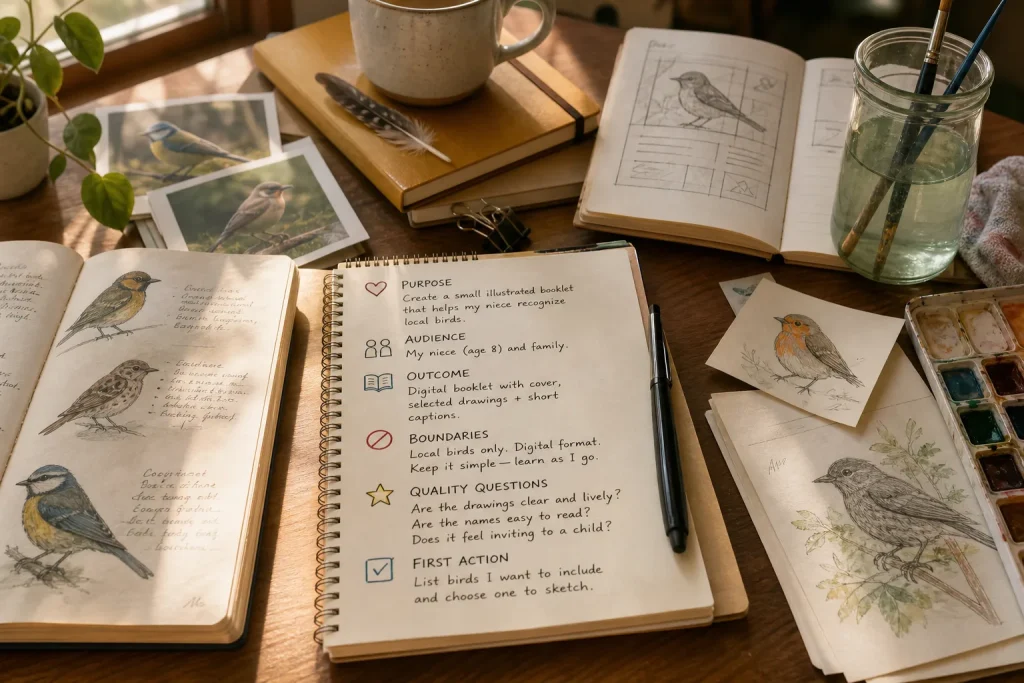
A personal project often begins with a vivid impulse: make a short film, assemble a family recipe booklet, or learn to draw the buildings on your street. The difficulty is not a lack of ideas but the gap between that impulse and a piece of work you can actually finish. A one-page brief helps bridge it. It is a compact note to yourself, not a contract or a polished pitch. By naming the purpose, setting boundaries and choosing a first concrete action, you create a practical reference for decisions as the project takes shape.
Define what the project is for
Begin with the reason the project matters to you now. “Make something creative” is too broad to guide choices; “make a small illustrated booklet that helps my niece recognize local birds” gives the work a human purpose. Write one plain sentence about what you want the finished piece to do, express or make possible. This is not a claim that the project will change anyone’s life. It is a compass for deciding what belongs and what can be left out.
Then identify the intended audience, even if that audience is only you. A private sketch collection can prioritize curiosity and experimentation. A booklet for a family member may need readable labels and a format that is easy to share. Keep the audience description specific enough to shape the work, but flexible enough to allow discovery. If the purpose and audience pull in different directions, note the tension rather than hiding it; that tension may be the project’s central creative question.
Choose a finish line you can recognize
Describe the outcome in observable terms. “Work on a bird project” has no clear stopping point, while “assemble a small booklet with a cover, selected drawings and short captions” gives you something to assess. The description does not need to predict every detail. It should make clear what a finished version contains and what someone could see, hear, read or use when it is complete.
Separate the essential finish line from optional additions. You might want custom lettering, a printed edition and a map of every birding spot, but those ideas can turn a modest project into a sprawling one. Mark a core version that would feel complete on its own, then place appealing extras in a “later” note. This keeps ambition alive without making every new possibility a requirement. When you review the finished work, judge it against the core promise first, not against features you never committed to make.
Set boundaries that protect the work
A useful brief says what the project will not try to do. Boundaries can concern format, subject, tools, collaborators or the kind of polish you are aiming for. For example, you might decide to make a digital booklet rather than research printing, or to draw familiar neighborhood birds instead of attempting a complete field guide. These limits are not apologies. They define a deliberate creative space in which choices become easier.
Write down the constraints that are genuinely relevant: available materials, a shared workspace, a particular skill you want to practice, or a reason to keep the project private. Avoid inventing strict rules just to make the brief look decisive. A boundary should help you choose, not punish you for changing your mind. If a constraint stops serving the purpose, revise the brief openly. The aim is a workable frame, not obedience to an early guess.
Make quality visible before you begin
“Make it good” is a feeling, not a useful review standard. Choose a few qualities that matter for this particular work. A recipe booklet might need legible instructions, a warm personal tone and images that clarify the dishes. A set of abstract collages might prioritize visual variety, intentional composition and a coherent presentation. The qualities should reflect the project’s purpose rather than borrowed ideas about what creative work is supposed to look like.
Turn each quality into a question you can ask when reviewing a draft. “Can a reader follow each recipe without guessing?” is more useful than “Is this professional?” Consider both craft and meaning: does the work communicate what you intended, and are its parts handled with care? Keep the standards few enough to remember. A brief should focus attention, not produce a scorecard that drains the pleasure from making. If a standard no longer fits what the project has become, adjust it and note why.
Choose a first action small enough to start
The first step should produce a visible change, not merely more planning. “Think about the booklet” can expand indefinitely. “List the dishes I want to include and choose one to draft” ends with a concrete decision. Other useful starts include gathering reference images, making a rough page layout, recording a voice memo, or creating one sample piece. Choose an action that moves the work from intention into material you can inspect.
Write the action as a verb-led sentence and note what you need to do it. If you cannot begin because a tool, permission or piece of information is missing, make that obstacle the first task. Resist designing an elaborate workflow before you have seen what the work requires. The first action is a doorway, not a promise about every later move. Once you have something to respond to, you can make better decisions about the next part.
Review the brief as the project changes
A brief is useful when it remains in conversation with the work. Revisit it after making an early draft or sample. Ask whether the purpose still feels relevant, whether the boundaries are helping, and whether your quality questions describe what you are trying to create. A mismatch may signal that the project needs a smaller scope, a clearer audience or a revised outcome. It does not automatically mean you have failed or that the original idea was mistaken.
At the end, compare the finished piece with the brief and make a short note about what held up and what changed. Did the chosen qualities help you notice weaknesses you could improve? Did an optional feature distract from the core? This review turns completion into useful creative knowledge without demanding a grand verdict. Keep the note with the brief so that the next project can benefit from what you learned, while leaving room for it to have a different purpose and shape.
Hypothetical worked example: a family recipe booklet
Imagine that you want to make a digital booklet of recipes from a relative’s handwritten notes. Your starting constraints are simple: the notes are unevenly legible, you have no permission to publish them publicly, and you want to practice arranging text and images. Your brief could say: “I will make a private, shareable booklet that preserves a small selection of family recipes in a readable form.” The core outcome is a cover, a few carefully transcribed recipes and a short note about the source. A public archive and extensive family history are explicitly outside the project.
For quality, you choose clear instructions, faithful transcription where legible, and a warm but uncluttered layout. Your first action is to select one recipe, type a draft and mark any words that need clarification. If a phrase cannot be read, you leave a visible query rather than silently guessing. The expected result is a sample page that reveals whether the layout works and which transcription questions need attention. The tradeoff is intentional: the booklet may be less comprehensive, but it stays private, manageable and honest about uncertainty.
A one-page brief cannot make the creative decisions for you, and it should not try. Its value is in making the project’s purpose, limits and first move visible while the work is still open to change. Write a version that fits on a page, make one concrete thing, then use the brief to assess whether that thing serves the project. When the finished result differs from the original picture in your mind, review it against the purpose and qualities you chose—not against every possibility you considered along the way.