How to Turn a New Skill into a Small Weekly Practice
Choose a useful learning goal, attach it to a realistic moment in your week, and use a brief review to decide what to practise next.
Starting a new skill can feel exciting until it competes with work, household tasks and the rest of ordinary life. The answer is not necessarily a bigger burst of motivation. A small weekly practice can make learning easier to return to because it gives you a clear action, a place for it in your routine and a way to adjust when the week changes. The aim is not to master a skill on a fixed timetable. It is to keep making deliberate contact with it.
This process works for skills that can be explored in short sessions, such as sketching, conversational language, bread making or spreadsheet basics. It begins with a narrow goal and ends with a decision about what to try next. Treat the plan as a useful draft: if a session proves too demanding, revise its size or timing rather than deciding that learning has failed.
Choose One Useful, Visible Learning Goal
Start by naming a small result you would like to produce, not a broad identity you hope to acquire. “Become good at drawing” is difficult to practise because it does not suggest what to do in a session. “Draw a mug using simple shapes and shadows” gives you a subject and a visible outcome. A language learner might choose to practise introducing themselves, while someone learning a kitchen skill might focus on preparing one unfamiliar vegetable.
Keep the goal close to your reason for learning. If you want to feel more comfortable speaking with visitors, begin with greetings and simple questions rather than collecting advanced vocabulary without a purpose. Write the goal in a sentence that makes it possible to tell whether you have attempted it. This does not need to be polished or ambitious; it needs to point toward an action you can take with the materials and time you actually have.
Break the Goal into a Manageable Session
Turn the goal into one practice activity with a clear beginning and end. For a sketch, that might mean choosing a household object, drawing its outline and adding one area of shading. For a spreadsheet skill, it could mean entering a few sample items and using a basic sort. A session should be small enough to begin without extensive setup, but substantial enough to leave you with something to notice or a question to carry forward.
Decide what you need before the session arrives. Put a pencil and paper where you can reach them, save a practice file in an easy-to-find place, or choose a recipe that uses ingredients already in your kitchen. Remove avoidable friction, but do not build an elaborate learning system. The best session is not the most impressive one; it is the one you can start, complete and evaluate without needing a perfect stretch of free time.
Give Practice a Realistic Place in the Week
Choose a recurring cue that already belongs to your routine, such as settling in after breakfast or sitting down after dinner. Then pair that cue with the small activity: after breakfast, practise a short language exchange; after dinner, sketch an object from the table. A cue is more dependable than a vague intention to practise “when there is time,” because it helps you decide when learning belongs in the flow of your week.
Make a backup plan for a disrupted day. You might move the session to another ordinary moment or use a shorter version that preserves the central action. If even that is not practical, note when you will resume instead of trying to repay the missed session with a punishing catch-up. A weekly practice is meant to support learning alongside other responsibilities. If the chosen time repeatedly clashes with real demands, change the cue rather than blaming yourself for the conflict.
Prepare Materials and Reduce Starting Friction
Gather only what the next session requires. A beginner practicing guitar might leave the instrument accessible and choose one chord transition to revisit; a cook might set aside a suitable pan and the recipe before beginning. For screen-based learning, close unrelated tabs and open the relevant lesson or practice document in advance. Keep materials simple enough that setup does not become a separate project that consumes the attention meant for practice.
It also helps to decide what counts as a completed session. That boundary prevents a brief practice from turning into an open-ended demand. You might stop after making one sketch and writing down a question, or after completing a single exercise and correcting one mistake. Leave a short note about where to resume. That note can be a reminder such as “try the darker shadow on the left” or “repeat the greeting without reading,” giving your next session a ready-made starting point.
Review What Happened and Choose a Next Action
At the end of the week, take a moment to review the plan. Ask whether the goal was clear, whether the session fit the available time and what felt confusing or satisfying. Focus on observable details: which part you practised, what you could do without prompting and where you paused. This is not a judgment of talent. It is information about whether the activity and its place in your routine are helping you return to the skill.
Choose one adjustment for the coming week. Keep the same activity if it still seems useful, make it smaller if starting felt difficult, or add a modest challenge if it has become familiar. Avoid changing the goal, materials and schedule all at once; a single adjustment makes it easier to see what suits you. The review can be brief, but it should end with a specific next action, such as repeating one exercise or trying the same skill with a new subject.
Worked Example: Practising Everyday Sketching
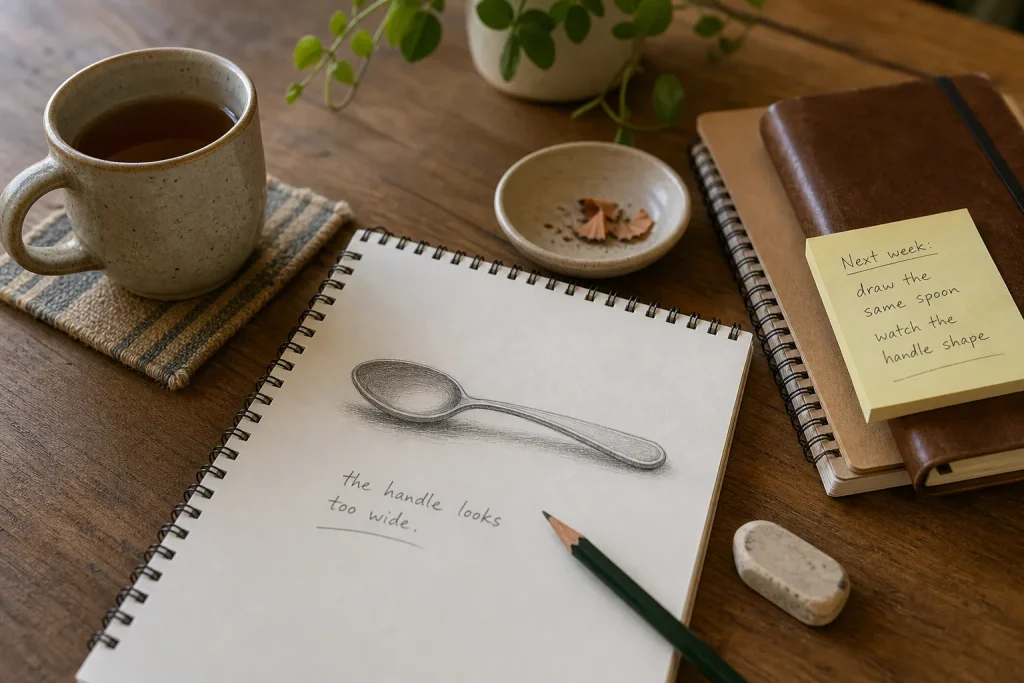
Hypothetical worked example: Imagine a beginner who wants to draw objects for a personal notebook, has only a pencil and plain paper, and often has a quiet moment after making tea on one weekend morning. The learner chooses the goal “draw a spoon with a clear outline and one shadow.” The session is to place a spoon on the table, look at its overall shape, make one outline and add a single shadow. The pencil and paper are left on the table the evening before, so the learner does not have to search for supplies.
After tea, the learner completes the drawing and writes “the handle looks too wide” beside it. The expected result is not a polished illustration but a finished attempt and a specific observation to use next time. In the weekly review, the learner decides to draw the same spoon again, paying attention to the handle’s shape. If the morning becomes busy, the backup is to make a quick outline later rather than add a longer session. The tradeoff is a deliberately narrow practice: it builds attention to shape, while leaving other drawing skills for later.
A small weekly practice turns learning from a distant ambition into a repeatable choice. Select one useful result, make the session concrete, attach it to a realistic cue and prepare only what you need. Then review what happened and choose one next action. Some weeks will be interrupted, and some activities will need reshaping. Returning with a clear, manageable task is more useful than waiting for ideal conditions. Over time, those modest decisions can make a new skill part of ordinary life.