A More Engaging Way to Read a Play
Choose a reading approach that suits your time and attention, then use character names, scene shifts, and stage directions to make the play’s action easier to follow.
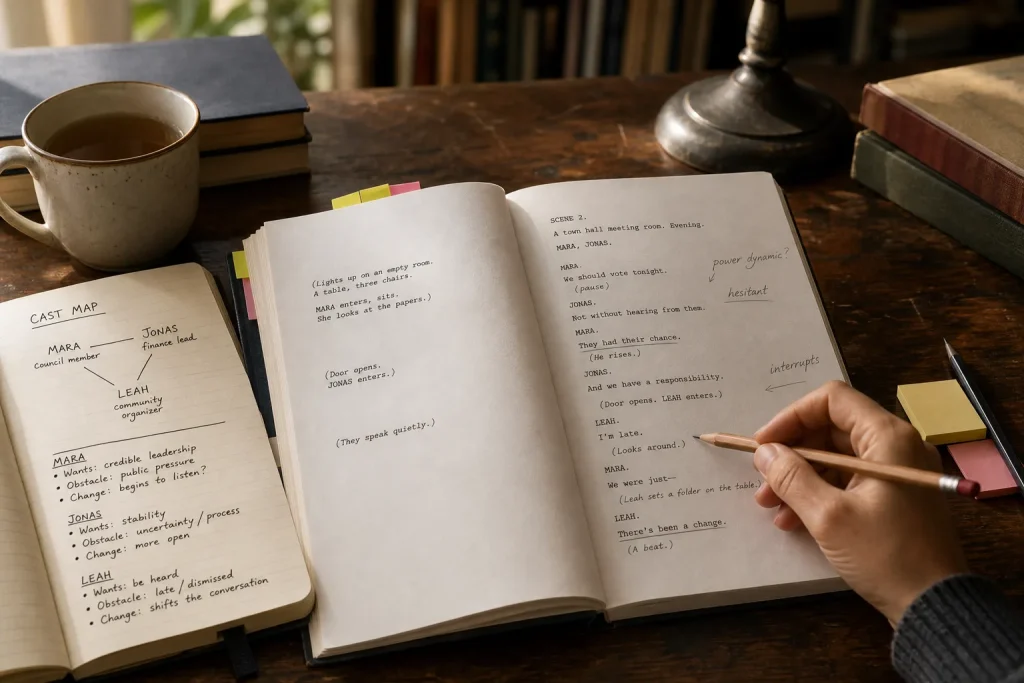
A play can seem unusually bare on the page. Dialogue carries much of the story, while entrances, pauses, and changes of place may be tucked into brief directions. The reader has to imagine not only what is said but who is present, what changes, and how each moment might play in a room. A useful approach is not to decode every line at once. Instead, choose a way of reading that fits your purpose, then follow a few concrete signals: character names, scene structure, and the directions that shape action.
Some readers want a quick sense of the whole plot; others want to hear the language or picture the staging. Those aims call for different habits. A first pass can prioritize momentum, while a slower pass can pause over a difficult exchange or a revealing entrance. Neither needs to be the “correct” way. The goal is to keep the play’s movement visible without turning reading into a scavenger hunt for hidden meanings.
Choose a reading approach that fits your aim
If you are new to a play or short on uninterrupted time, read for the broad movement first. Notice the opening situation, the event that unsettles it, and the choices characters make afterward. Resist the urge to stop for every unfamiliar phrase. A brief note beside a scene can capture what has changed, leaving interpretation for later. This approach is especially helpful when a cast is large: the central question of a scene gives names and relationships a context.
For language that rewards close attention, take a slower route. Read a short exchange aloud, or silently shape the lines as if they were spoken, and notice where punctuation changes the pace. A reader interested in performance might mark a pause, a turn, or a sudden shift in tone, while someone focused on plot can move on. You can also combine the methods: make one flowing pass, then return to passages where a character’s words and actions seem at odds.
Make a simple map of who is present
Before reading, scan the cast list if one is provided. Group names by family, workplace, friendship, or another relationship the play makes clear; avoid guessing beyond the text. During a scene, track entrances and exits in the margin or with a small cast list of your own. This helps explain why a conversation changes when someone arrives, or why a character speaks differently in front of one person than another. If names are unfamiliar, a compact note such as “Mara—council member” can be more useful than repeatedly searching backward.
Character tracking need not become a biography project. For each important figure, note a desire, an obstacle, and one change in how they behave. Keep these as questions rather than verdicts: “Wants approval?” is more flexible than deciding the character is simply vain. If a character’s motive remains unclear, record the uncertainty and look for later evidence. The play may deliberately keep a person difficult to read, and that tension can be part of the experience rather than a problem to solve immediately.
Follow the structure through scenes and turning points
Scene breaks are practical signposts. At each new scene, note what has changed: the setting, the time, the people present, or the balance of power. Then ask what the scene adds that could not have happened in the previous one. A quiet conversation may introduce a threat; a comic exchange may expose a serious disagreement. These observations build a loose map of the play without forcing every moment into a rigid formula.
Pay attention to decisions and consequences. When a character makes a choice, mark what becomes possible or more difficult afterward. That sequence often clarifies the structure more than a list of events does. If the plot appears to wander, ask whether a recurring object, promise, secret, or conflict is gathering significance. Avoid assuming that every detail must become a clue. Some moments establish atmosphere or give performers room to create a particular rhythm, and that too is part of the play’s design.
Read stage directions as part of the action
Directions can be brief, but they often shape how dialogue lands. A pause may make a reply feel reluctant; an interruption may show that one character controls the exchange. Stage directions also establish practical facts: who enters, where attention goes, or whether an object is handled. Notice these details before imagining elaborate scenery. They provide the play’s own cues, while leaving room for different productions and readers to picture the stage differently.
It helps to distinguish what the direction states from what you infer. If it says a character turns away, that action is given; deciding the character feels ashamed is an interpretation. Keep both in view, especially when the dialogue suggests something different from the movement. Where no direction is supplied, do not treat the silence as a missing instruction. The playwright may be leaving that choice to performers, directors, and readers. Imagining alternatives can make the text feel more open rather than incomplete.
Choose between reading silently, aloud, or with others
Silent reading offers control over pace and makes it easy to revisit a line or track a long scene. It suits readers who want to follow structure without arranging a performance. Reading aloud can reveal whether a sentence feels blunt, evasive, playful, or difficult to say. You do not need a full cast: changing your voice slightly for each speaker is enough to hear when an exchange becomes confusing. If speaking aloud feels awkward, simply mark where you would breathe or pause.
Reading with another person can clarify who is speaking and make interruptions easier to hear, but it is not necessary for understanding the play. Agree on a light format: alternate scenes, assign recurring roles, or read only a short exchange. Pause afterward to compare impressions rather than settle on one interpretation. A group can be lively, yet it may also slow the reading or make a private, quiet play feel performative. Choose the social method only when it helps you attend to the text.
Use a small set of questions, not a decoding contest
A few recurring questions can keep attention active: Who wants what in this scene? What prevents them from getting it? What changes by the end? Which direction affects how the words might sound? These prompts work across comic, tragic, and experimental plays because they invite observation rather than impose a single reading. If a question yields nothing useful, leave it aside. An image, rhythm, or atmosphere may be what holds your attention, and that is a valid route through the work.
Keep notes selective. A symbol key, a short scene summary, or a question mark beside an unclear exchange can help you return without interrupting every page. After finishing, look back at the notes and identify one change in your understanding. Perhaps a character’s repeated refusal now seems protective rather than stubborn, or a stage direction has altered the tone of an earlier line. Let such conclusions remain revisable; a later performance or rereading may offer another plausible emphasis.
Hypothetical worked example: choosing a method for a busy reader
Imagine a reader beginning a play with a large cast, several scene changes, and only a short quiet window each evening. Their constraints are limited attention and uncertainty about who belongs to which household. They choose a momentum-first pass, scan the cast list, and jot a few relationship labels. At the end of each scene, they write one sentence describing the change and note any entrance that shifts the conversation. They leave unfamiliar references unmarked unless the plot depends on them.
When the reader reaches a tense exchange whose meaning depends on pauses, they switch methods for that passage: they read it aloud, mark an interruption, and compare the spoken rhythm with the direction on the page. The expected result is a clearer scene map and a more vivid sense of that exchange, with some references still unresolved. The tradeoff is deliberate: this approach favors continuity over exhaustive annotation. A reader seeking language analysis could instead slow down throughout, but this hypothetical choice gives a time-pressed reader a complete route through the play.
Conclusion: Let the play’s form guide your attention
Reading a play becomes more engaging when the method serves the reader rather than the other way around. A broad first pass, a character map, close attention to scene shifts, or an occasional aloud reading can each make different aspects of the text easier to notice. Stage directions offer evidence, while open spaces in the script leave room for imagination. You do not need to use every technique on every page.
Begin with the part that interests you most, then adjust when attention falters or a scene asks for a closer look. Track who is present, what changes, and how words meet action. Let unanswered questions remain when the text leaves them open. The result is not a single definitive interpretation, but a more attentive reading—one that follows the play’s movement while making space for your own response.