A Calm Way to Sort a Crowded Kitchen Drawer
Make one crowded kitchen drawer easier to use by clearing it, grouping its contents, and arranging everyday tools around how you cook.
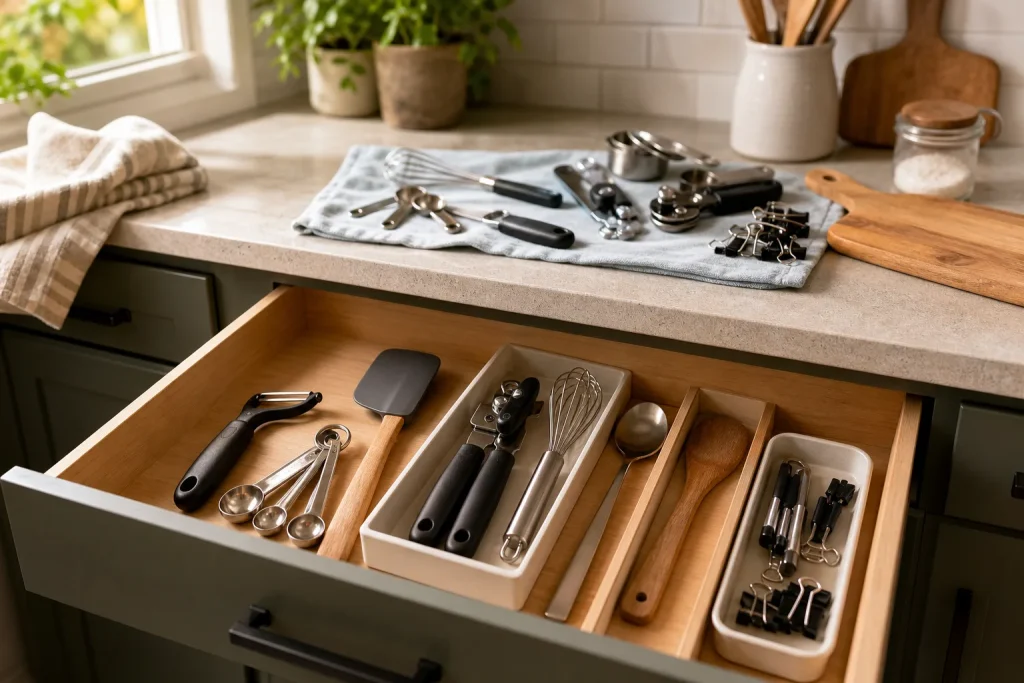
A crowded kitchen drawer can make a small task feel surprisingly frustrating: you reach for a peeler and shift a tangle of clips, spare utensils, and tools you rarely use. The fix does not require a new organizer or a full kitchen overhaul. It begins with one drawer and a few practical decisions about what belongs there and how you reach for it.
Set aside a short stretch when you can work without needing the drawer mid-task. Gather a towel or tray for temporary sorting, then focus on making the contents visible. The goal is not a picture-perfect arrangement. It is a drawer where useful things have a sensible place and can be returned there without effort.
Choose one drawer and define its job
Start with a single drawer rather than emptying several at once. Choose the one that causes the most daily friction, such as the drawer where cooking tools collect or the one beside the main food-preparation area. Before moving anything, decide what the drawer should help you do. A drawer near the stove might hold tools used while cooking; one near the counter might serve food preparation.
This purpose is a guide, not a rigid rule. Consider who uses the drawer and whether children or other household members need to reach particular items. If the drawer has to serve several tasks, make room for the most frequent ones first. A clear job helps you judge each object later: keep it here if it supports the drawer’s purpose, and look for another home if it does not.
Empty the drawer and inspect what you have
Take everything out and place it on a clear surface, using a towel or tray to keep small pieces from scattering. Remove crumbs and wipe the drawer before putting anything back. As you lift each item, notice its condition and whether it is complete: a usable whisk is different from one with a loose handle, and a can opener is only helpful if its parts work together.
Keep decisions simple. Set aside items that belong elsewhere, such as batteries, loose papers, or tools meant for a different room. Put damaged or unusable objects in a separate discard pile, following local disposal guidance when a material needs special handling. If you are unsure whether an item is useful, set it aside briefly rather than letting hesitation slow every decision. Return to that small group after the obvious choices are made.
Group tools by the task they support
Arrange the remaining items into loose groups based on what you do with them: cutting, stirring, opening packages, measuring, or serving. The groupings should reflect your routine, not a universal kitchen taxonomy. A small household may have little need for a separate category for baking tools, while someone who cooks often may want those tools together.
Notice which items overlap. If several tools perform nearly the same job, keep the one that feels comfortable and works well for your usual meals, unless another person regularly relies on a different option. Keep accessories with their matching tool when separation would make them harder to find. This stage is about seeing the collection clearly; do not worry yet about making the drawer look orderly.
Arrange items around reach and frequency
Put the tools you reach for most often in the easiest part of the drawer to access. Place less-used items toward the back or in a secondary location, as long as they remain easy to retrieve. Keep long utensils from lying across smaller tools, and place sharp edges so they are not exposed when you reach into the drawer. If the drawer contains a blade or other potentially hazardous tool, store it in a way that protects hands and suits the household.
Use the drawer’s shape as a guide. A shallow section can hold small, flat tools, while a longer area may suit spatulas or serving spoons. A simple divider, small tray, or sturdy container can separate loose items, but it should fit without blocking the drawer. If an organizer makes the contents harder to lift or the drawer harder to close, leave it out and try a simpler arrangement.
Try the layout before making it permanent
Place the main groups in the drawer and open and close it gently. Check whether handles catch, items tip into neighboring groups, or a frequently used tool gets buried. Then pretend to follow a familiar task: reach for a spoon, a peeler, or the tool you use to open a package. If the movement feels awkward, adjust the group rather than blaming yourself for not remembering the layout.
Ask other regular users to locate an ordinary item, if that makes sense for your household. Their ease or hesitation can reveal whether a category is unclear or a tool is in the wrong place. Keep labels out of the way unless they genuinely help. The best arrangement is usually one that makes sense at a glance and remains easy to maintain when someone is putting things away in a hurry.
Use a hypothetical worked example
Hypothetical worked example: Imagine a drawer beside a food-preparation counter containing a peeler, two can openers, several loose clips, a measuring spoon set, a spatula, and a few tools used only for occasional baking. The household often prepares simple meals there, but the drawer is too crowded for the peeler to come out easily. The specific constraint is that the drawer must still close freely and be usable by everyone who cooks.
First, the household removes everything, wipes the drawer, and sets aside the clips for a container elsewhere. They compare the can openers, keep the one that works comfortably, and move the occasional baking tools to a separate kitchen location. They group the peeler, measuring spoons, and spatula by their everyday tasks, placing the peeler near the front and the longer spatula along the side. The expected result is a clearer route to frequent tools, with the tradeoff that less-used baking tools require a separate reach.
Conclusion
A calm drawer comes from making a few useful choices: give it a job, see everything it contains, group tools by task, and place frequent items within easy reach. A divider can help, but it is optional; the arrangement matters more than the accessory.
After using the drawer for ordinary kitchen tasks, notice what still feels awkward and make one small adjustment. Keep the system simple enough that everyone can put things back. When the drawer is easy to open, scan, and use, the sorting has done its job.